
As an Amazon Associate, we earn from qualifying purchases at no extra cost to you.
Quick Answer
Dog separation anxiety is not a behavior problem. It is a panic disorder. The difference matters because everything you try based on the wrong diagnosis will fail — and for six months, everything I tried failed. What finally worked was a combination of a pheromone diffuser, a compression vest, and a complete change in how I left the house. Here is the full honest breakdown.
The Incident
It started the week I went back to working from the office three days a week. My dog Biscuit — a four-year-old beagle mix who had spent eighteen months glued to my side during remote work — began destroying things. Not chewing toys. Destroying things. A couch cushion on day one. A section of baseboard on day three. By day five he had pulled the blinds off the window and was sitting in the middle of the wreckage when I got home, shaking.
I thought it was boredom. I bought more toys. I hired a dog walker. I tried leaving the TV on. I tried leaving a worn t-shirt with my scent. None of it touched the behavior. The destruction continued. The shaking continued. My neighbor texted me that Biscuit had been howling for two hours straight.
What I Got Wrong for Six Months
The mistake I made — the one most dog owners make — is treating separation anxiety like a training problem. You cannot train a dog out of a panic response any more than you can train a human out of a phobia by telling them to calm down. The anxiety happens before the dog has any capacity to make decisions. By the time the destruction starts, Biscuit is already in full panic. Corrections, distractions, and rewards cannot reach a brain in that state.
What I needed was to lower his baseline anxiety level so that departures did not trigger the panic threshold in the first place. That required two things working together: environmental intervention and physical intervention.
What Finally Worked
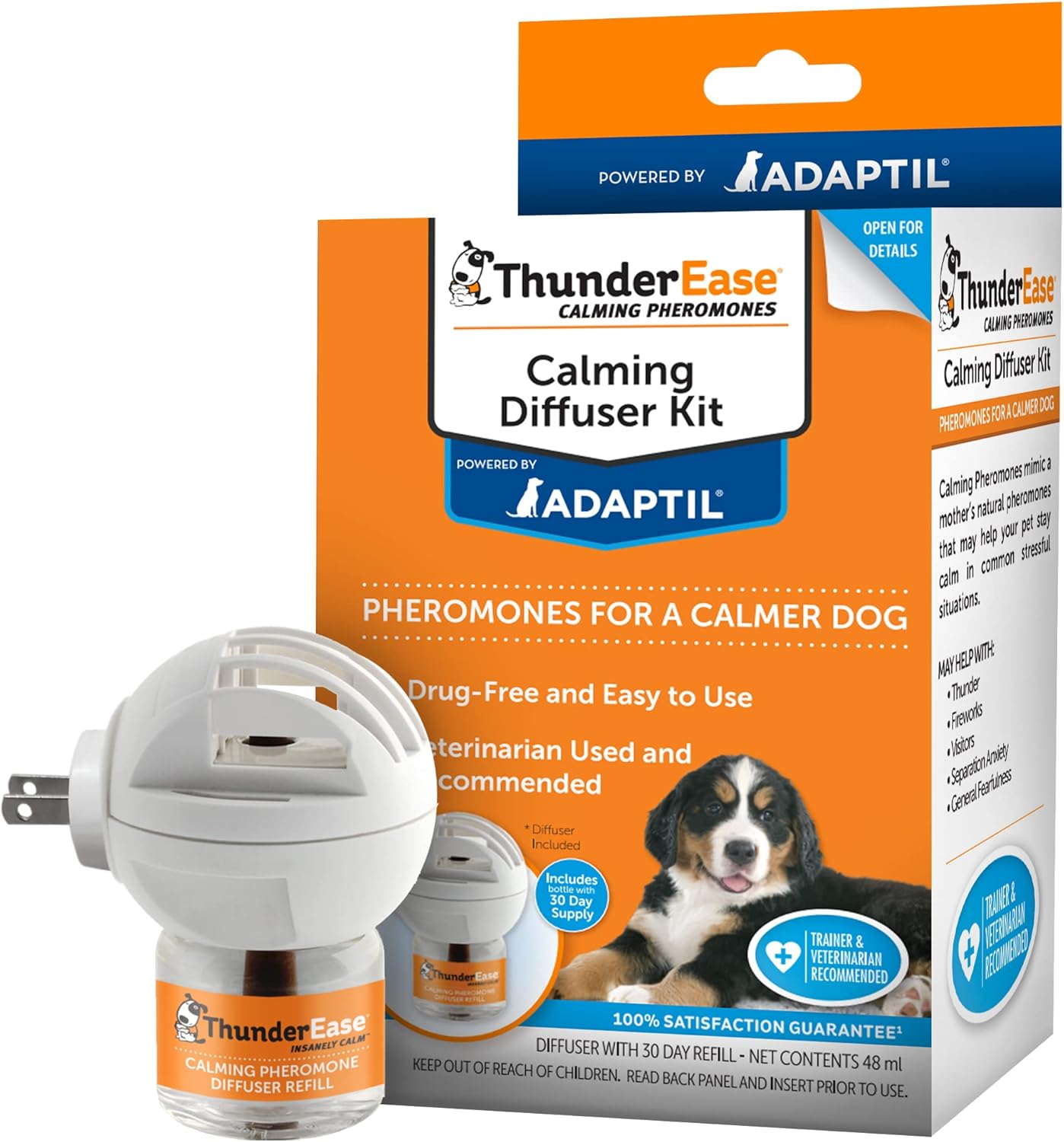
ThunderEase Dog Calming Pheromone Diffuser Kit — $24.99 (30-day supply). Powered by ADAPTIL, vet-recommended, and the first thing that produced a measurable change in Biscuit’s behavior. Pheromone diffusers work by releasing a synthetic version of the calming pheromone mother dogs produce for their puppies. It does not sedate — it lowers the ambient stress level in the environment. I plugged it in near his crate two weeks before I went back to the office. By week two his resting behavior had visibly changed. He was sleeping more during the day and startling less at sounds. I cannot prove causation, but the timing was not a coincidence.

ThunderShirt Platinum Sport Dog Anxiety Vest — $49.99. I resisted buying this for months because it looked like a gimmick. It is not a gimmick. The constant gentle pressure it applies works on the same principle as swaddling an infant — it activates the parasympathetic nervous system and reduces arousal. I put it on Biscuit 15 minutes before I leave, not at the door. Putting it on at the door just becomes a departure cue that triggers anticipatory anxiety. The timing matters. Within three weeks of consistent use, the howling stopped. The destruction dropped to zero over the following month.
The third piece was behavioral, not a product: I completely changed my departure routine. No long goodbyes. No eye contact at the door. I leave the same way every time — keys, coat, out. Dogs with separation anxiety read departure cues acutely. Disrupting the ritual disrupts the anticipatory panic that builds before you even leave.
What Six Months of Anxiety Cost
One couch cushion replacement: $140. Baseboard repair: $200. Dog walker for three months while I figured this out: $480. Vet consultation: $85. Total: $905. The diffuser and the ThunderShirt together cost $74.98. I spent $905 arriving at a $75 solution because I was diagnosing the wrong problem for six months.
FAQ
How long does it take for the pheromone diffuser to work?
Most owners report noticeable changes in 2-4 weeks of continuous use. It works best when started before the stressor — if you know a schedule change is coming, start the diffuser two weeks early. One 30-day refill covers approximately 700 square feet.
Does the ThunderShirt work for all dogs?
Research suggests it works for approximately 80% of dogs. The 20% it does not help tend to be dogs with severe anxiety who need medication in addition to behavioral intervention. If you have tried the ThunderShirt consistently for four weeks with no change, talk to your vet about pharmaceutical support — this is not a failure, it is just a different level of the same problem.
Should I crate my dog if they have separation anxiety?
It depends on the dog. For some dogs, a crate provides a safe den-like space that reduces anxiety. For others, confinement amplifies panic. Watch your dog’s reaction to the crate when you are home. If they enter voluntarily and rest calmly, crating during absences may help. If they resist or show stress, confinement is making it worse.
Related Posts
5 Best Dog Toys in 2026 (Tested Best Sellers Compared)
5 Best Interactive Dog Toys in 2026 (Keep Your Dog Busy for Hours)
The Best Dog Beds in 2026 (Tested and Reviewed)